
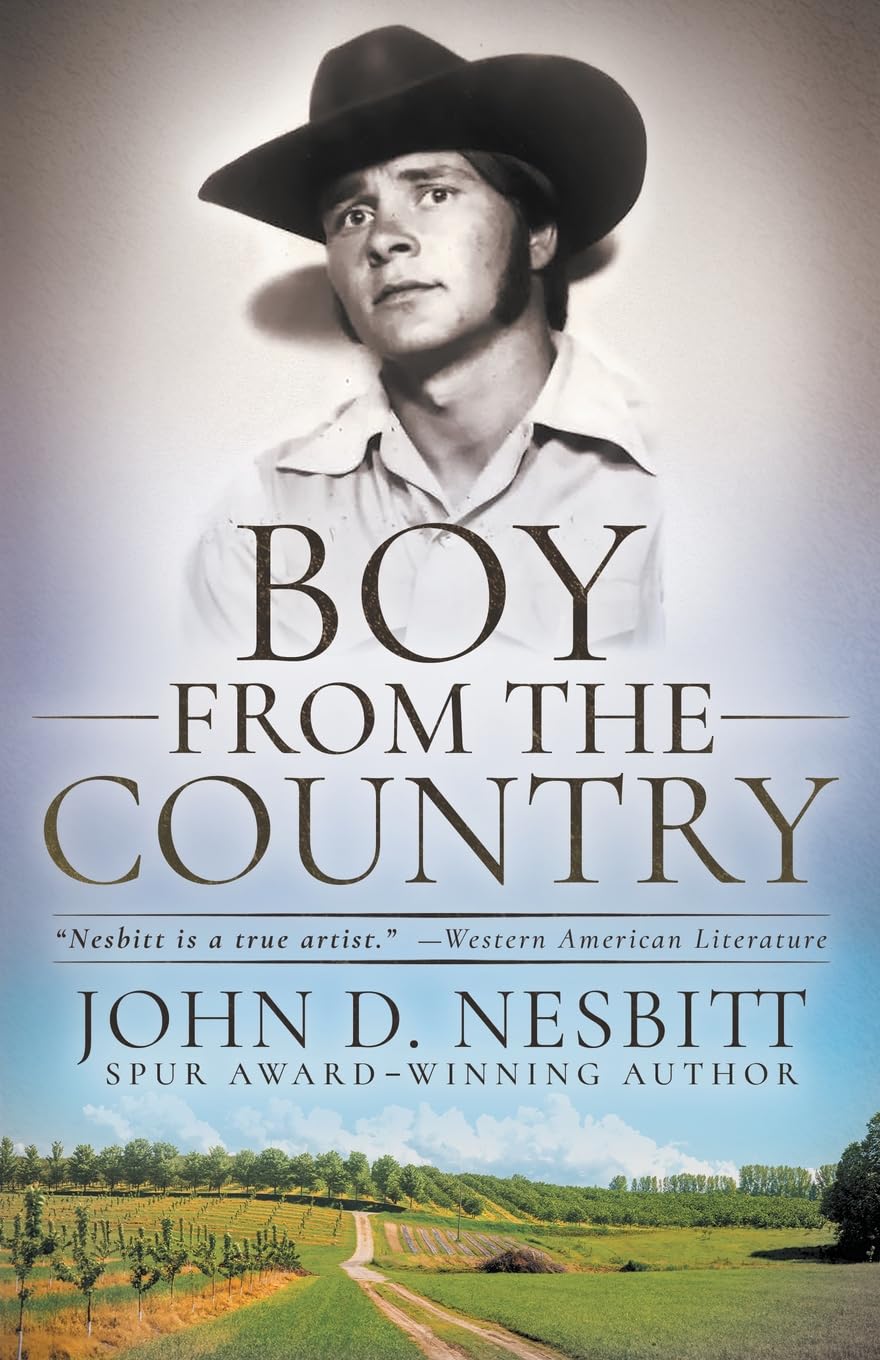
Boy from the Country is an autobiographical work of nonfiction, not quite my life story but a part of it. As I have said more than once about writing this kind of work, one of the biggest challenges is in having to decide what to leave out. I discuss this consideration in the Preface to the work:
During the many years that I pondered this work, I came to call it a spiritual autobiography, a term I borrowed with some irony from an interpretation of Moll Flanders and Robinson Crusoe. What is now called a memoir is a selective autobiography, narrowing to some aspect of the author’s experience. This story is about a boy who grows up poor in a difficult family situation, works in the fields, has a little trouble with the law, becomes educated, and goes on to have a career as an educator and as a writer. I could not tell my whole life story in one volume, for I have a pretty good memory and volumes of journals and notes. So I have focused on this aspect, which I hope is a tribute to the value of education in our country and to the aspiration of every individual who wishes to rise from difficult circumstances.
To say that I pondered this work for many years is an understatement. Not only did I make notes and notes to add to all of my journal entries and personal experience writings, but I also went around and around with myself about how to organize or put a fence around my material. The idea I came back to most often is the one expressed in the Preface above, so I laid that out for myself as what some people call a through line, or organizing idea or principle. Then I tried to stick to it.
Although I had written quite a few personal experience pieces and had had several of them published, I wrote most of this longer work from scratch. In a few places, I adapted a piece I had written earlier. No matter what I wrote about, I checked for accuracy. In some cases, I checked to be sure I had my geography correct, as the story goes to quite a few locations when we lived and worked in so many different places. I also checked dates, to be sure that I was accurate with references to contemporary events, songs, movies, and the like. I consulted my journal, my personal documents such as high school and college transcripts, school photos, yearbooks, and in some cases, correspondence. I had also read my brother David’s history of our family through 1946 and had visited with him and corresponded with him about more recent genealogical work he had done. In some of my communication with him, I had reviewed many of my own resources and had resurrected some memories and some stretches of chronology.
Because I had quite a bit of material to cover, I had to decide when to write in-scene narration and when to write a more generalized kind of narration. In the latter part of the work, I had to narrate at a faster pace and leave out a great deal more than I wanted in order not to make the whole thing too long and not to throw it out of balance after what I considered to be the high point.
One solution to the problem of what to leave out, or what to do with what I left out, is to write another volume. That is not out of the question. I just need to see if I have a substantial enough idea or organizing principle. Content itself is interesting, but most readers are going to want a “So what?”
For the present, I am very glad that this work has been published. I am grateful to Wolfpack Publishing for taking a chance on it, as nonfiction is outside their usual territory. Of course I hope that this work has a good reception, and I hope it is interesting to the people who read it.
Boy from the Country is available at Amazon.
Leave a Reply
You must be logged in to post a comment.